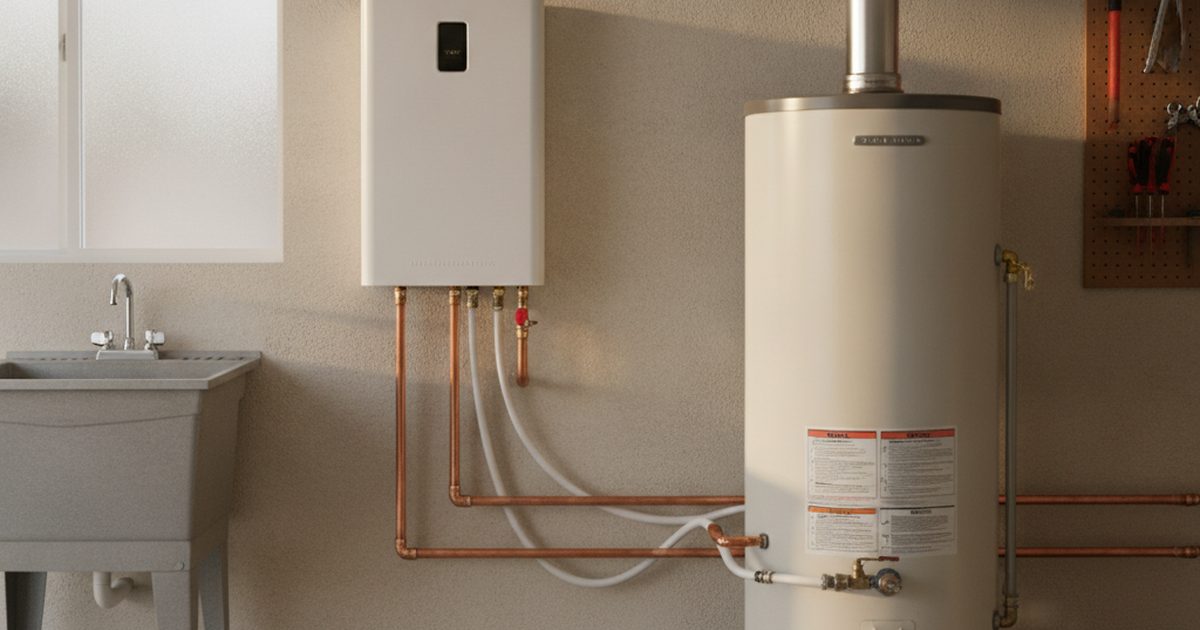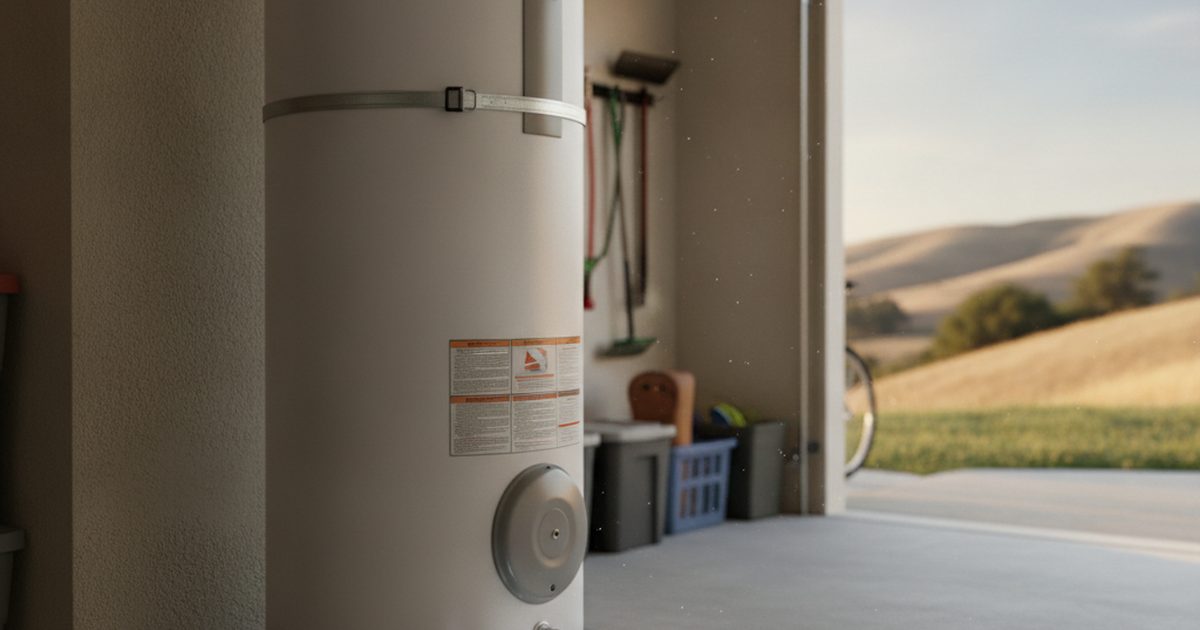

A water heater rarely fails without warning. Rusty water, popping from the tank, hot water running out early, or a damp patch under the unit are all signals that it is near the end. In the Santa Clarita Valley, hard water usually brings that end forward by a year or two.
Why this matters more here than elsewhere
Water across the valley carries a heavy mineral load. That is not a health problem, but it is hard on a water heater. Minerals settle out of the water and collect at the bottom of the tank as sediment.
Sediment sits directly between the burner and the water it is meant to heat. The burner has to run longer to reach the same temperature, which wears the unit and quietly raises your gas bill.
| Water condition | Typical tank life |
|---|---|
| Soft water, flushed yearly | 12 to 15 years |
| Hard water, flushed yearly | 10 to 12 years |
| Hard water, never flushed | 6 to 9 years |
Those last two rows describe most homes in Valencia, Saugus, and Canyon Country. An annual flush is the single cheapest thing you can do for a tank, and almost nobody does it.
The eight signs worth paying attention to
Some of these mean call today. Others mean start planning. The difference matters, because a replacement you plan for is easier to price and schedule than one forced on you by a failed tank.
- No hot water at all. The burner, thermocouple, or element has failed.
- Hot water runs out early. Sediment is taking up tank volume.
- Rusty or brown hot water. The tank lining has gone.
- Water pooling at the base. The tank is leaking and cannot be repaired.
- Popping or rumbling noises. Steam escaping through settled sediment.
- A rotten egg smell. Bacteria in the tank, often fixable.
- Rising gas bills. A scaled burner working harder than it should.
- Age over ten years. Statistically, you are on borrowed time.
The ones that mean replacement, not repair
Two of those eight are terminal. If water is pooling around the base of the tank, the steel has rusted through from the inside and no repair exists. Welding a domestic water heater is not a thing anyone does.
Rusty water from the hot taps only, with clear water from the cold, points the same way. The glass lining inside the tank has broken down and the steel beneath it is corroding. Once that starts, it does not stop.
The ones that are often just a repair
A pilot that will not stay lit is frequently a thermocouple, which is an inexpensive part. No hot water on an electric unit is often a heating element or a tripped reset switch. Both are worth checking before anyone talks to you about replacement.
The rotten egg smell surprises people, but it is usually bacteria reacting with the anode rod rather than anything sinister. Flushing the tank and replacing the rod frequently clears it entirely.
What the age of your heater actually tells you
Every tank has a rating plate, and the serial number encodes the manufacture date. The format varies by brand, but most start with a letter or two for the month and two digits for the year. If you cannot decode it, we can.
Here is the honest framing. A heater under eight years old with a component fault is worth repairing. A heater over twelve with any fault is worth replacing. Between eight and twelve, it depends on what has failed and what you would spend on the repair.
- Under 8 years, minor fault: repair it
- 8 to 12 years, major fault: usually replace
- Over 12 years, any fault: replace
- Any age, leaking tank: replace
What replacement costs and what moves the price
There is no honest single number for a water heater replacement, and anyone quoting one over the phone is guessing. What we can do is explain what the price is built from, so you can judge a quote when you get one.
The heater itself is often less than half the total. The rest is labour, code compliance, permit, and disposal of the old unit.
| Cost driver | Why it matters |
|---|---|
| Fuel type | Gas installs cost more than electric |
| Tank size | 40, 50, and 75 gallon units price apart |
| Code upgrades | Straps, drip pan, expansion tank |
| Access | Attic and closet installs take longer |
| Permit | Required for replacement, plus inspection |
| Disposal | The old tank has to go somewhere |
Watch out for quotes that seem low
A quote noticeably below the others usually excludes something. The common omissions are the permit, the seismic strapping, the expansion tank, and hauling the old unit away. All four are things you will end up paying for anyway.
Ask any plumber directly whether the permit is included. In California a water heater replacement requires one, and an uninspected install can surface later as a problem when you sell the house.
Sizing: the mistake people make when replacing
Most people replace like for like, and most of the time that is correct. But households change. Say you replaced a 40 gallon tank ten years ago, when there were two of you. If there are now four, you will keep running out of hot water however new the unit is.
The rough guide below works for most homes. Bathroom count matters as much as people count, because simultaneous demand is what empties a tank.
- 1 to 2 people, 1 bathroom: 40 gallons
- 2 to 3 people, 2 bathrooms: 40 to 50 gallons
- 4 to 5 people, 2 or more bathrooms: 50 to 75 gallons
- Frequent simultaneous showers: consider tankless
This is also the natural moment to ask whether a tankless water heater makes sense. The conversion costs more, mostly in gas and venting work, but the tank never runs out and you get the floor space back.
How to get more life out of the heater you have
None of this reverses a failing tank, but on a healthy unit it genuinely adds years.
- Flush the tank once a year. It clears settled sediment before it bakes on.
- Check the anode rod every few years. It corrodes so the tank does not.
- Set the thermostat to 120 degrees. Hotter means faster scaling and a scald risk.
- Insulate the first few feet of hot pipe. Cheap, and it reduces burner cycles.
- Consider softening the water. This is the one that changes the timeline most.
That last point is worth dwelling on. If you have already replaced two heaters early, the water is telling you something. A water softener or whole house filter treats the cause rather than the symptom, and it protects every other appliance in the house at the same time.
What to do the moment you find a leaking tank
A leaking water heater goes from a damp patch to a flooded garage faster than people expect. The tank holds forty gallons or more, and once the steel gives way it empties itself.
Five minutes of the right action saves a great deal of damage.
- Shut the cold supply off. There is a valve on the pipe entering the top of the tank.
- Turn off the power or the gas. Electric at the breaker, gas at the valve on the line.
- Do not just open the drain valve. Attach a hose and run it outside first.
- Move anything off the floor. Cardboard, tools, and stored boxes soak it up fast.
- Then call a plumber. With the water off, you have time to choose properly.
That third step catches people out. The instinct is to open the drain immediately, which simply moves the water onto your floor rather than out of the building. Attach the hose first.
If you cannot find the cold supply valve, or it will not turn, shut the main off at the meter instead. Knowing where that main valve is, before you ever need it, is worth ten minutes on a quiet afternoon.
When to call a licensed plumber
You can safely check the age on the rating plate, look for water around the base, and listen for popping. Those are homeowner jobs.
Do not attempt gas line work, venting changes, or a tank replacement yourself. Gas appliances vent combustion products, and getting that wrong is genuinely dangerous rather than merely expensive. Water heater replacement also requires a permit and an inspection in California.
Call straight away if water is actively pooling near the unit, or if the temperature and pressure relief valve is discharging. That valve exists to stop a tank becoming a hazard, and it triggering is not a minor event. If you smell gas, leave the house and call SoCalGas or 911 from outside first.
Need a Plumber in Santa Clarita? BluePoint Plumbing Is Ready to Help
If your water heater is showing any of the signs above, we would rather look at it now than replace it in an emergency later. We serve Valencia, Saugus, Newhall, Canyon Country, Castaic, Stevenson Ranch, and Acton.
We hold California contractor licence 1140216, we pull the permit as part of the job, and we take the old tank away with us.
Call us at (661) 235-5878 or contact us today to arrange water heater installation in Santa Clarita and the surrounding areas.