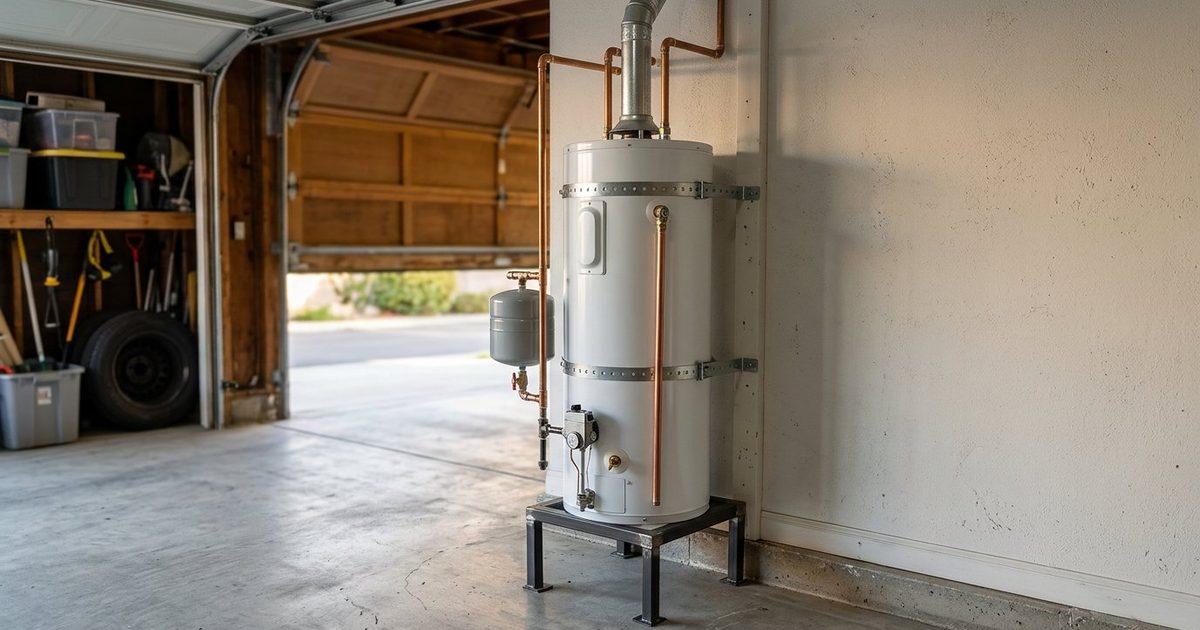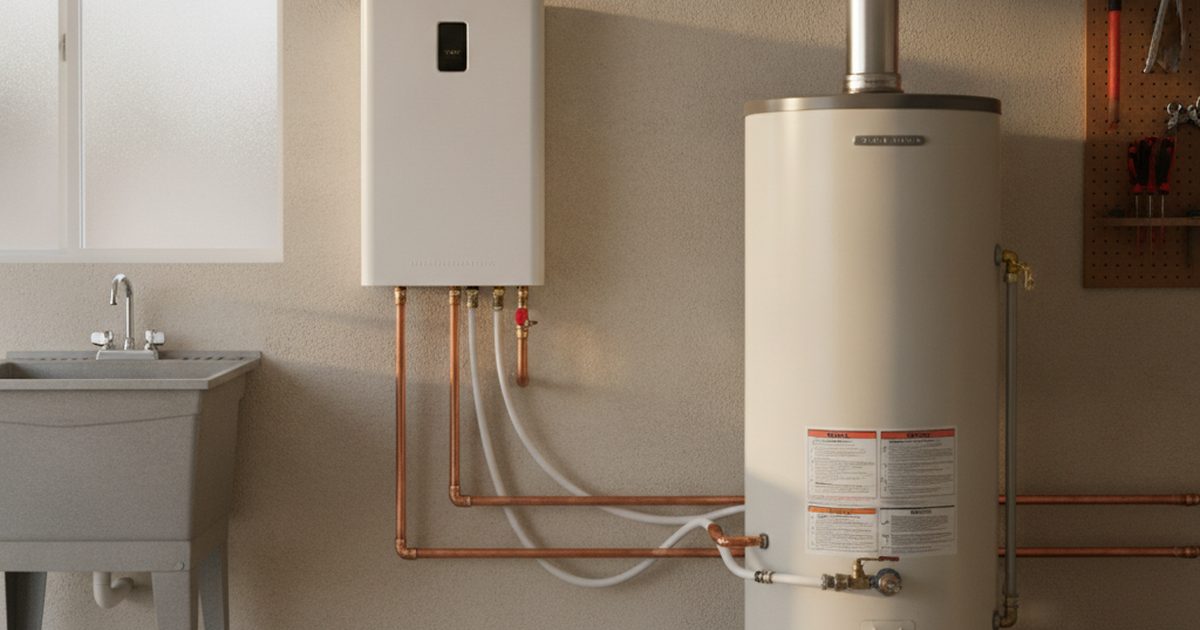

A tankless water heater is sized by flow rate, not by gallons: the number of hot taps your household runs at the same time, and how many degrees the unit has to warm the cold water coming into the house. Most Santa Clarita homes with two or more bathrooms need a full-size gas unit that can carry two showers at once on a winter morning, and the gas line feeding it matters as much as the heater.
That is the short version. Below is how to work out the number for your own house, why the same house needs more heater in January than in July, and what to check on any tankless quote before you sign it.
Why the tank size does not carry over
With a tank, you pick a size in gallons. A 50-gallon tank stores 50 gallons of hot water, and when it runs out, everyone waits.
A tankless unit stores nothing. It heats water as it passes through, so it never runs out, but it can only heat so many gallons per minute. If the demand goes past that, the water coming out of the taps gets cooler instead of running out. So the question changes from "how much hot water do we use in a morning?" to "how much hot water do we use at the same moment?"
That is why replacing a 50-gallon tank with "the tankless equivalent" is not a real thing. The right tankless size depends on your fixtures and your habits, not on what was there before.
The Building America Solution Center, the U.S. Department of Energy's building guidance run by Pacific Northwest National Laboratory, puts it simply: "Sizing is based on the practical maximum flow rate needed at any one time." It also notes that typical hot water supply temperatures are near 120°F (Building America Solution Center, gas-fired tankless water heaters).
Step 1: count what runs at the same time
Start with the busiest moment in your house. For most families that is a weekday morning or the hour after dinner. Write down what could realistically be running at once:
- Showers. Each running shower is the biggest single draw. Two people showering in different bathrooms is the usual peak.
- The kitchen sink. Hot water for washing up runs for a few minutes at a time.
- The dishwasher and washing machine. Many modern machines heat some of their own water, but they still pull from the line.
- A tub. Filling a large soaking tub is a heavy draw for several minutes.
Then be honest about overlap. A couple in a two-bedroom townhome in Valencia rarely runs more than one shower at once. A family of five in a four-bedroom house in Stevenson Ranch might have two showers, the dishwasher and the kitchen tap going together.
Every fixture has a flow rate, and newer showerheads and faucets are lower-flow than older ones. When we size a unit, we look at what is actually installed in your bathrooms and kitchen, add up the fixtures that overlap at the peak, and that total is the flow the heater has to carry.
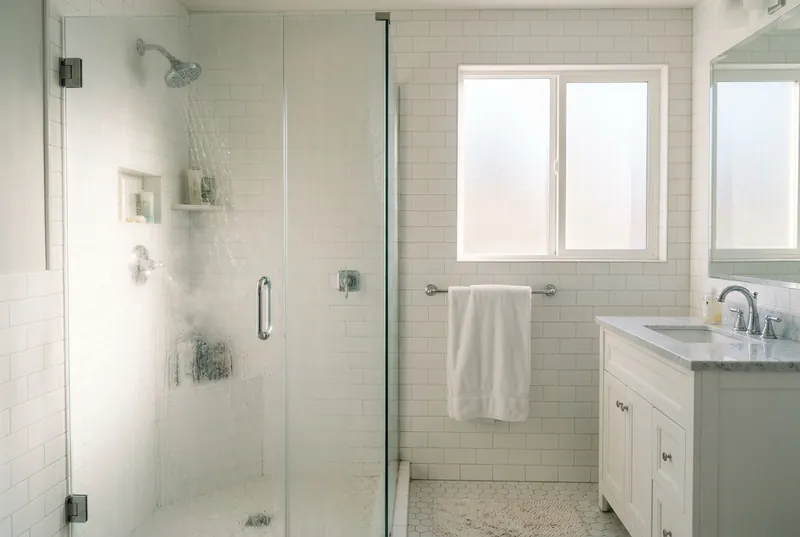
Step 2: work out the temperature rise
The second half of sizing is the temperature rise: the difference between the cold water entering the house and the hot water you want at the tap.
If you want water at about 120°F and the water reaching your house is cold, the unit has to raise it a long way. If the incoming water is warmer, it has less work to do and can deliver more gallons per minute at the same setting.
Every tankless unit has a chart that shows how many gallons per minute it can deliver at each temperature rise. The same unit delivers noticeably fewer gallons per minute at a large rise than at a small one. That chart, not the big number on the box, is what to size against.
Why a Santa Clarita home needs more heater in winter
The cold water coming into your house is not the same temperature all year. In summer, the supply lines and the ground they run through are warm, so the water arrives warmer. On a December or January morning it arrives noticeably colder, and a tankless unit has to work harder to bring it up to temperature.
That matters in the valley because the winter mornings are exactly when people take long hot showers. A unit that keeps up easily in August can fall behind in January if it was sized for the summer.
Homes in Acton and the higher parts of Canyon Country see colder winter nights than central Valencia, and outdoor tankless units there need their freeze protection working. If your house is on well water, as many in Acton and parts of Castaic are, the water temperature can be different again.
So we size for the coldest water your house is likely to see, not the average. It costs a little more up front and it is the difference between a unit that just works and one that runs lukewarm on the mornings you notice it most.
Step 3: check the gas line before you pick the unit
This is where most tankless conversions go wrong, and it is the part people do not expect.
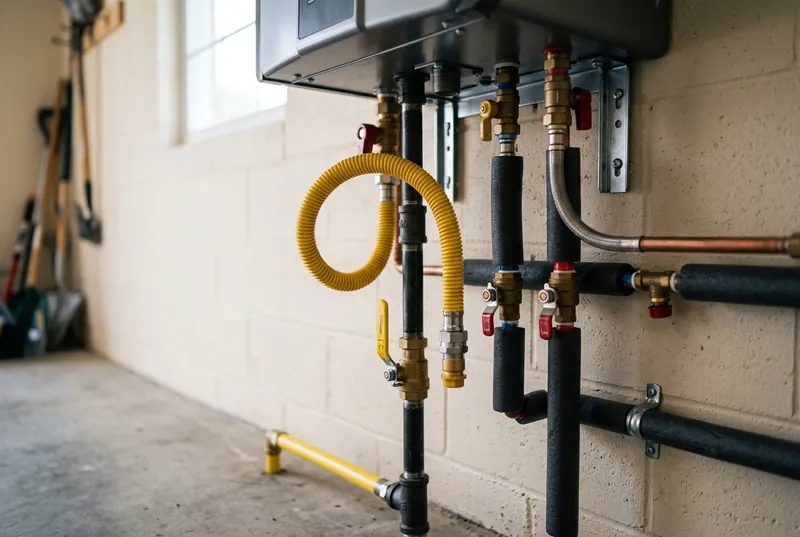
A tank heater has a small burner that runs slowly for a long time. A tankless unit has a large burner that fires hard the moment a hot tap opens. The Building America Solution Center notes that tankless water heaters typically have burner capacities of 120,000 to 200,000 Btu/h, and that because fuel-fired tankless water heaters have much larger burners, they often require larger gas lines (same source).
In practice, most homes plumbed for a tank cannot feed a full-size tankless unit on the existing line. When the gas supply is too small, the unit cannot reach its rated output, and the hot water drops off when you need it most. It has nothing to do with the heater being too small. The fix is upsizing the gas line from the meter, which is part of a proper conversion. If you have other gas appliances, such as a furnace, a range or a pool heater, the line has to carry them all at once.
If you are already planning other gas work, for example a line out to an outdoor kitchen, it makes sense to look at the whole gas supply at the same time. Our outdoor kitchen gas line guide covers how we size a run like that.
Venting and where the unit goes
A tankless unit also needs its own vent. Condensing units, the more efficient type, run cooler exhaust and can usually vent through a side wall. Non-condensing units need a vent rated for hotter exhaust. Either way, the vent is part of the job and part of the price.
In this climate, mounting the unit outside on an exterior wall is often an option. An outdoor model avoids most of the venting work, which can bring the cost of the conversion down and frees up the garage.
What size do most Santa Clarita homes end up with?
We will not give you a number without looking at the house, because the fixtures and the gas supply decide it. But the pattern is consistent:
| Household | What usually fits |
|---|---|
| One bathroom, one or two people | A smaller unit, or a point-of-use unit for a single far fixture or a casita |
| Two bathrooms, typical family | A full-size whole-house gas unit that can carry two showers at once in winter |
| Three or more bathrooms, large tub, big family | A high-output unit, or two units linked together |
Undersizing is the common mistake, and it is the one people live with every winter morning. A unit that is slightly bigger than the summer peak is usually the right call.
Hard water and how long the unit lasts
Santa Clarita water is hard, and scale builds on a tankless heat exchanger over time, slowly cutting the flow the unit can deliver. A unit sized right on day one can feel undersized a few years later if it is never descaled.
Two things protect it: descaling once a year, which our guide to flushing a tankless water heater walks through, and treating the water before it reaches the heater. We install salt-free conditioning and whole-home filtration, and our hard water guide explains the options.
What a tankless quote should include
Before you compare prices, check that each quote covers the same job:
- The flow rate the unit is sized for, and which fixtures it assumes run at once
- The gas line: whether it is being upsized, from where, and that it is in the price
- Venting: the vent type and route, or an outdoor unit that does not need one
- The permit and inspection, and who files it and meets the inspector
- Water treatment: whether the quote mentions scale, given our water
Two tankless quotes can be far apart, and the difference is usually the gas and vent work one of them left out. If you are still deciding whether tankless is right for your house at all, our tankless vs tank comparison covers that choice.
Get your tankless water heater sized properly
BluePoint Plumbing installs tankless water heaters and converts tank systems across the Santa Clarita Valley. We count your fixtures, check what your gas line can supply and size the unit for a winter morning, then give you a written price before anything comes apart. We file the permit and meet the inspector. A real person picks up, Monday to Saturday, 6 AM to 5 PM. See our tankless water heater installation service in Santa Clarita or contact us to book a visit.